 Help
Help
Written by Olena Lastivka
Olena is a nutrition and healthcare writer, runner, and gym enthusiast. She is keen on health and fitness research, modern studies on sports and nutrition, and various physical activities.
Creatine is not a magic pill or silver bullet, but it can become a game-changer in your fitness routine. Read on to discover how creatine affects your body and what other factors might influence weight gain.
You might know that creatine is a popular sports supplement for athletes who want to gain muscle or lose weight. But in fact, it is an amino acid synthesized by your body and primarily stored in your skeletal muscles. Its main function is to generate energy, which helps you exercise in the gym or lift heavy weights in daily life1Kreider, Richard B et al. (2017, June 13). International Society of Sports Nutrition position stand: safety and efficacy of creatine supplementation in exercise, sport, and medicine. Journal of the International Society of Sports Nutrition DOI:10.1186/s12970-017-0173-z.
Eat tasty food and lose weight with Unimeal app!
Take a Quiz – Get personal meal plan – Achieve your weight goals!
Start Quiz
You can get creatine from such foods as red meat, oily fish, and yolks. Creatine as a sports supplement has several forms: monohydrate, gluconate, nitrate, and ethyl ester. There is no significant difference between them, but creatine monohydrate is the most popular.
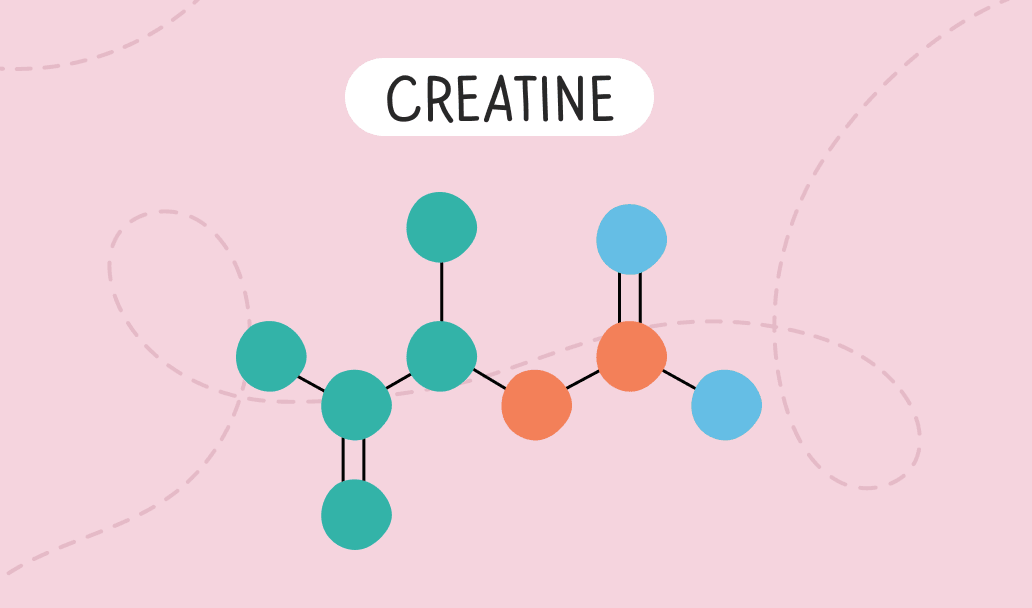
The effects of creatine as a sports supplement are the same for women and men. It helps to refill creatine in your muscles during strength, HIIT, or other resistance training sessions. It allows you to take bigger weights, do more reps, and be more endurant in general1Kreider, Richard B et al. (2017, June 13). International Society of Sports Nutrition position stand: safety and efficacy of creatine supplementation in exercise, sport, and medicine. Journal of the International Society of Sports Nutrition DOI:10.1186/s12970-017-0173-z.
As creatine helps increase your training volume, it contributes to muscle growth and overall training performance. That is why creatine is popular in strength training, but don't rely only on it.
Creatine might not be so effective in muscle-building if you don't increase your workout intensity or calorie intake. That is why you should pay attention to all variables that affect your training, including nutrition, exercise volume and form, sleeping hours, stress levels, etc.
Creatine itself doesn't make you gain weight because it is low in calories. One creatine serving contains 0 to 5 calories and doesn't make you gain or lose weight. The best instrument to control your weight is monitoring your diet and exercise, which affect your body image more significantly.
However, creatine makes your appetite better and allows you to train more. It also helps you recover between sets, which enables you to gain muscle quicker if combined with proper nutrition2Antonio J, Candow DG, Forbes SC, Gualano B, Jagim AR, Kreider RB, Rawson ES, Smith-Ryan AE, VanDusseldorp TA, Willoughby DS, Ziegenfuss TN. (2021, February 8). Common questions and misconceptions about creatine supplementation: what does the scientific evidence really show? J Int Soc Sports Nutr DOI:10.1186/s12970-021-00412-w. The best way to gain weight is to make sure that you eat in a calorie surplus and add creatine as a supplement.

Several studies have shown that you can gain a couple of pounds of muscle mass even without working out. The problem is that these are not long-lasting or visible gains. These small results will gradually disappear when you stop taking creatine3Wu SH, Chen KL, Hsu C, Chen HC, Chen JY, Yu SY, Shiu YJ. (2022, March) Creatine Supplementation for Muscle Growth: A Scoping Review of Randomized Clinical Trials from 2012 to 2021. Nutrients. DOI:10.3390/nu14061255.
In general, the supplement will go to waste if your creatine reserves are full and muscles don't spend creatine on activities2Antonio J, Candow DG, Forbes SC, Gualano B, Jagim AR, Kreider RB, Rawson ES, Smith-Ryan AE, VanDusseldorp TA, Willoughby DS, Ziegenfuss TN. (2021, February 8). Common questions and misconceptions about creatine supplementation: what does the scientific evidence really show? J Int Soc Sports Nutr DOI:10.1186/s12970-021-00412-w. The creatine you take will go past your muscles to your kidneys and bladder.
As your muscle creatine reserves are always full while taking the supplement, you might have higher energy levels2Antonio J, Candow DG, Forbes SC, Gualano B, Jagim AR, Kreider RB, Rawson ES, Smith-Ryan AE, VanDusseldorp TA, Willoughby DS, Ziegenfuss TN. (2021, February 8). Common questions and misconceptions about creatine supplementation: what does the scientific evidence really show? J Int Soc Sports Nutr DOI:10.1186/s12970-021-00412-w. It can lead to higher daily activity and weight loss if you don't increase your calorie intake.
You can experience some weight fluctuations when you start taking creatine and mistake it for fat gain. In most cases, it is just bloating or water retention in your muscles2Antonio J, Candow DG, Forbes SC, Gualano B, Jagim AR, Kreider RB, Rawson ES, Smith-Ryan AE, VanDusseldorp TA, Willoughby DS, Ziegenfuss TN. (2021, February 8). Common questions and misconceptions about creatine supplementation: what does the scientific evidence really show? J Int Soc Sports Nutr DOI:10.1186/s12970-021-00412-w. The only thing that can make you fat is eating more calories than you burn and not exercising enough. In this case, you will not build muscle. You will gain weight that will go directly to fat storage.
Creatine does not affect your fat metabolism as it is low in calories. If you think you bloat too much, take a break from creatine for a couple of days. You will see that your weight will return to normal.
Typically, creatine makes you store water in your muscle tissues. As a result, your muscles look fuller and more prominent. It is also normal that your body looks bloated when you start taking creatine, especially if you have decided to begin with a loading phase. Try to drink more water and eat less sugary and salty foods to speed up water circulation and avoid bloating4Powers ME, Arnold BL, Weltman AL, Perrin DH, Mistry D, Kahler DM, Kraemer W, Volek J. (2003 January-March). Creatine Supplementation Increases Total Body Water Without Altering Fluid Distribution. J Athl Train. PMID:12937471.

Creatine is completely safe if you use it according to the instructions provided with the supplement1Kreider, Richard B et al. (2017, June 13). International Society of Sports Nutrition position stand: safety and efficacy of creatine supplementation in exercise, sport, and medicine. Journal of the International Society of Sports Nutrition DOI:10.1186/s12970-017-0173-z. However, you should consult your doctor if you are currently taking any medication or have any health conditions.
Buy creatine only from certified sports nutrition stores. Supplements of bad quality can lead to digestion problems, excessive bloating, or skin problems.
As for healthy people, better not use more creatine than is written on the package to avoid a high load on your liver and heart. It is also unlikely to improve your strength and muscle gains.

Creatine is a great sports supplement that can help you build muscle mass or lose weight. It can help you become stronger and more endurant. But remember that creatine is just a slight enhancement, while the most important factors in your progress are nutrition, exercise, and recovery. If these factors are in order, you can take the most out of creatine and see desired results much faster.
Sources:
By choosing high-quality sources, we make sure that all articles on the Unimeal blog are reliable and trustworthy. Learn more about our editorial processes.
1.
2.
3.
4.
Related Articles